
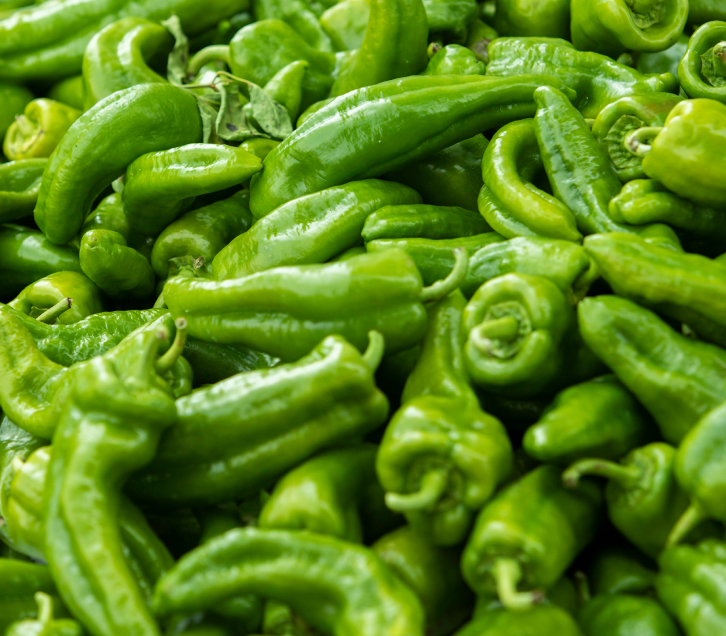
The Italian frying pepper, the one everyone grew up with
On this page
There’s a pepper almost everyone has eaten at home and very few people can name: the
Italian frying pepper. Thin, long, pale green and with skin so fine you eat it
unpeeled.
It isn’t the same as the big, square green pepper of salads, even though in many greengrocer’s they
sit side by side. And the difference shows the moment you put the two in the same pan.
What sets it apart
| Italian frying pepper | Big green pepper | |
|---|---|---|
| Shape | Long and narrow | Wide, square |
| Skin | Very fine | Thick |
| Flesh | Thin | Fleshy |
| Flavour | Sweet and mild | More grassy |
| For frying | Perfect | Ends up leathery |
| For salad | Possible, raw | Its natural use |
The key is the thickness. The Italian has walls so thin that in the pan it softens straight away and
browns without turning tough. A thick pepper needs far longer and ends up leathery outside and raw
inside.
Nor should it be confused with the Padrón pepper, which is much smaller, eaten whole in two bites
and famous for occasionally being hot. The Italian is considerably longer — fifteen to twenty
centimetres — and gets cut into strips or served whole alongside meat or eggs.
When it’s in season
From June to October, at its best between July and September. It’s a heat plant,
and in the Ribera it’s what, along with the aubergine, fills the months when there isn’t a single
citrus to pick: when the orange trees are loaded with green fruit,
the market garden is the only thing coming off the
land.
How to choose one
- Firm and stiff. If it bends like a glove, it has lost water.
- Smooth, glossy skin, with no wrinkles or soft patches.
- Pale, even green. Ones starting to turn red are sweeter, but they soften
sooner. - A green, fresh stalk. Dry and dark means it was cut days ago.
- Light. Unlike fruit, a heavy pepper usually has thicker walls than you want.
How to fry them properly
It looks like there’s nothing to it, and yet most of the complaints — that they spit, that they come
out oily, that the skin peels off — come down to three details.
Dry them thoroughly
The number one cause of spitting. The water from washing turns to steam the moment it touches hot
oil and jumps. Washed and dried with a cloth, one by one.
Prick them or make a cut
A whole pepper is a closed bag full of air and moisture. As it heats, the pressure rises and it
bursts, with boiling oil around it. One prick with the point of a knife before they go in prevents
it.
Hot oil, but not smoking
Medium-high heat. If the oil is lukewarm, the pepper absorbs it while it warms up; if it’s smoking,
the skin burns before the flesh softens. The sign is that they sizzle when they go in, not that a cloud
comes off.
Salt at the end
Salting them first draws out water and drops the pan’s temperature. Coarse salt over the top once
they’re out, which is also where it sticks best and shows most in the first bite.
What to do with them
- Fried, with egg. The classic: fried peppers, an egg on top and bread. Nothing else
needed. - With garlic, in strips. Over a low heat until they collapse, and they go with
everything. - In a ratatouille, with aubergine, which is in
season exactly the same months. - Roasted and peeled, in strips with oil and salt. With such fine skin, it comes
away by itself after fifteen minutes covered out of the oven. - Stuffed, if they’re among the thicker ones in the batch.
The roast pepper trick
As they come out of the oven, put them in a bowl and cover it with a plate. The steam they give off
loosens the skin by itself, and in fifteen minutes it comes away with two fingers. With the Italian it
works even better than with the big red pepper.
And if one is hot
It happens now and then and it’s disconcerting, because the Italian is one of the sweet ones.
Peppers produce capsaicin — the compound behind heat — as a defence, and a plant
that has been through extreme heat or a lack of water can raise its production. In a batch grown
outdoors, the odd piece can come out hot with nothing being wrong.
It’s exactly the same phenomenon as Padrón peppers, where some are hot and some aren’t. In field
fruit and veg, variation between pieces is normal: it’s set out in
why untreated fruit doesn’t all look alike.
Green or red: it’s the same pepper
It’s one of those things that surprises people: the green pepper and the red pepper of the
same variety are the same fruit at two moments. Green is the fruit still unripe; red is that
same fruit once it finishes ripening on the plant.
What changes as it ripens
- The sugar rises. A red pepper is clearly sweeter.
- The grassy note softens, that green flavour a lot of people dislike.
- Vitamin C increases, which grows during ripening.
- And it softens. It keeps fewer days and spoils sooner.
Why it’s picked green
For two practical reasons. One, that green the plant produces more: every fruit left to ripen fully
holds back the next ones. And two, that green it stands transport and storage considerably better.
In a seasonal batch some pieces usually turn up starting to turn, with reddish patches. It isn’t a
fault and they aren’t past it: they’re the ones that stayed a little longer on the plant, and they’re
usually the sweetest in the box. Worth eating before the green ones, though.
And if you want them to ripen at home
It half works. A freshly cut green pepper goes on turning off the plant if left somewhere warm, but
it doesn’t gain the sugar it would have made on the bush. It’s the same story as fruit cut too early,
set out in what seasonal fruit means.
How to keep them
- In the fridge, a week to ten days, in the salad drawer and not in a sealed
bag. - Outside, three or four days somewhere cool.
- Unwashed until you use them. Moisture spoils them faster than anything.
- Away from apples and tomatoes, which give off ethylene and soften them.
Freezing them
Here’s the good news: peppers freeze well, and they’re one of the few vegetables that hold up
raw. Washed, dried, stalk and seeds removed and cut into strips, they go into a bag
and come out loose. Six months. Thawed they lose their crunch, so they’re for stews and sofritos, not
salads.
Fried they freeze too: cooked, drained and in portions. It’s the best way out when the plant crops
heavily all at once, which is what the market garden does: it doesn’t produce at a steady rate, it
produces in waves, which is why one week there’s none and the next there’s plenty.
Ours
The Italian frying pepper is picked in Albalat de la
Ribera through the warm months and leaves for your home within 24 or 48 hours, with no cold store and
no waxing — that shop-window shine on some shelf vegetables is
wax, just as it is on fruit.
They arrive in different lengths and thicknesses, because the plant doesn’t give two the same. They
are in the vegetables section while the season lasts, along with the
aubergine, the Chinese cabbage and the two squashes.
What’s the difference between an Italian pepper and an ordinary green one?
The Italian is long, with very fine skin and thin walls, which is why it
fries well and doesn’t need peeling. The big green one is fleshy and thick-skinned: better raw or
roasted, and leathery when fried.
Why do peppers spit when you fry them?
Because of the water from washing and the air inside them. Dry them
thoroughly with a cloth and prick them or make a cut before they go into the oil.
Why is an Italian pepper sometimes hot?
Because the plant produces capsaicin as a defence, and extreme heat or a
lack of water can raise it in individual fruit. It’s the same phenomenon as Padrón peppers: some are
hot and some aren’t.
Can frying peppers be frozen?
Yes, and they’re one of the few vegetables that hold up frozen raw: cleaned,
deseeded and in strips, up to six months. They lose their crunch, so they’re used in stews and
sofritos. Fried, they also freeze well.
When is the Italian frying pepper in season?
June to October, at its best between July and September. It’s a heat plant
and, along with the aubergine, it’s what gets picked in the months with no citrus.
Search the blog
Right now in the fields
Being picked in September:
Lemons · Orange blossom honey · Italian frying pepper · Aubergine · Squash
Latest
From the tree to your door
It’s picked the day we prepare your order and leaves Albalat straight for your door.
What's available this week
The catalogue changes with the fields: it shows what’s being picked and hides what isn’t.