
Why orange blossom honey crystallises
On this page
It’s the question we get most about the one thing in the catalogue that isn’t fruit: the jar has
been in the cupboard for two months, you open it and the honey is solid, grainy and
paler. The usual reaction is to think sugar has been added or that it has gone off.
Neither. Crystallisation is a natural process and, if anything, it’s a sign that the honey
is real. Here’s what’s happening inside the jar.
What crystallising is
Honey is essentially a supersaturated solution of sugars: there’s more sugar dissolved in it than
the little water it contains can hold in solution. It’s an unstable balance by definition.
Over time, some of the glucose separates from the water and forms solid crystals,
which grow and draw in more glucose. The honey goes from liquid to thick and from thick to solid, and
turns paler because the crystals reflect the light.
Nothing else changes. Not the flavour, not the properties, not the amount of
sugar. It’s the same honey in a different form.
It’s a reversible process, in fact: it can be made liquid again with gentle heat and it will
crystallise again later, as many times as needed. What’s in the jar is exactly the same in both
states.
Why some honeys crystallise sooner than others
It all depends on the ratio between the two main sugars.
| If it has more… | What happens |
|---|---|
| Glucose | It crystallises soon and with a fine grain |
| Fructose | It stays liquid much longer |
That ratio is decided by the flower it came from, not by the packer. Which is why acacia honey can
spend a year liquid and rapeseed honey solidifies in weeks.
| Type of honey | Time to crystallise |
|---|---|
| Acacia | A year or more |
| Chestnut | Six months to a year |
| Orange blossom | Three to six months |
| Wildflower | Two to six months |
| Rosemary | Two to four months |
| Sunflower or rapeseed | Weeks |
The particular case of orange blossom
Orange blossom honey sits in the middle: it usually starts to crystallise between three and
six months, and it does so with a fine grain and a creamy rather than gritty texture. As it’s
harvested in April, a jar bought in summer will normally start to thicken as autumn comes in.
In other words: if it arrives liquid in August and is solid by December, everything is going
exactly as it should. And if the jar you opened last year took longer, that’s fine too: every harvest
has its own exact balance of sugars and no two seasons are identical.
The one that never crystallises is the suspicious one
This is the point worth holding on to, because it runs against intuition.
Honey can stay liquid indefinitely for three reasons, and none of them is good:
- It has been pasteurised. Heating it above 70 degrees dissolves the microcrystals
that act as seeds, and without seeds crystallisation takes far longer. In exchange, enzymes and aromas
are degraded. - It has been microfiltered. Filtering under pressure removes the particles of
pollen and wax that also act as nuclei. The honey comes out transparent and with no trace of its
origin. - It has been adulterated. Mixed with sugar syrups, which don’t crystallise the
same way.
How to turn it liquid again
You can, and it’s reversible as often as you need. There’s only one rule: gentle
heat.
A bain-marie, which is the right way
A pan of hot water — below 40 degrees, so you can put a finger in without burning
it — and the jar inside, lid off or loose. Stir now and then and in fifteen or twenty minutes it’s
liquid again.
The radiator, if you’re in no hurry
Leaving the jar near a gentle heat source for a few hours works just as well and needs no watching.
What not to do
- The microwave. It heats unevenly and within seconds there are areas above 60
degrees. It’s the fastest way to turn good honey into syrup. - Boiling water. Above 40 or 45 degrees the enzymes and volatile aromas start to
break down, which is exactly what tells orange blossom honey apart from sweet syrup. - Doing it every week. Each heating cycle takes something off. If you’ll use it over
months, only liquefy the part you need.
Or don’t melt it: use it as it is
Before heating anything, it’s worth asking whether you need to. Crystallised honey has practical
advantages that liquid honey doesn’t.
It spreads and doesn’t run
On toast, on bread and butter or on fresh cheese, solid honey stays where you put it instead of
running off the edges onto the plate. It’s why creamed honeys are sold exactly like
that: they’re honeys crystallised on purpose.
It measures better
A teaspoon of solid honey is a teaspoon. A teaspoon of liquid honey ends up being twice that by the
time it reaches the yoghurt.
And you can make it creamy at home
If the grain has come out coarse and gritty, there’s a trick: stir the jar with a spoon every day
for a week, or beat it once at low speed. Breaking the large crystals forms much finer ones and the
texture ends up like a spread. Nothing is added.
In baking, it makes no difference
For a dough or a sauce it doesn’t matter at all which state it’s in: it’s going to dissolve anyway.
It only matters in raw uses.
How to slow it down
It can’t be prevented, but it can be delayed:
- Between 18 and 25 degrees. That’s the range where it goes slowest. Curiously, the
point where it crystallises fastest is around 14 degrees. - Never in the fridge. The commonest mistake: cold speeds it up.
- Jar tightly closed. Honey absorbs moisture from the air and that encourages
crystals, as well as potentially fermenting it. - Out of direct light. A cupboard, not the worktop by the window.
- A dry spoon. A wet teaspoon puts water in the jar, and water is exactly what you
don’t want.
What is a problem
Honey going solid is normal. These three things aren’t.
Foam and bubbles
If foam appears on the surface, it smells of alcohol or vinegar and the jar looks about to overflow,
the honey is fermenting. That happens when it has too much moisture, either because
it was harvested early or because the jar has been badly closed somewhere damp.
Separation into two layers
A solid, pale layer at the bottom and a liquid, darker one on top is uneven crystallisation. It
isn’t dangerous, but it usually indicates excess moisture. Liquefying and stirring sorts it out.
An odd smell or taste
Properly kept honey doesn’t go off: edible jars have been found in tombs thousands of years old. If
it tastes fermented or burnt, something happened earlier.
Orange blossom honey, and why there’s only one chance a year
It comes from the orange blossom, which lasts three or four weeks in April. It’s
the only window in which the bees can make it, and it’s the same blossom that will give the following
winter’s oranges.
It’s sold all year because, kept properly, it lasts years without losing anything. It’s the only
product in our catalogue that doesn’t depend on the month you order it, and
it’s also what keeps the lemon company when
there are no oranges in summer.
Our jar is one kilo, raw and unpasteurised, so it
will crystallise. When it does, you know what it means.
Has crystallised honey gone off?
No. Crystallising is a natural process in which glucose separates from the
water and forms solid crystals. It doesn’t change the flavour, the properties or the amount of sugar:
it’s the same honey with a different texture.
Does crystallising mean sugar has been added?
Quite the opposite. Honeys adulterated with syrups tend to stay liquid. Honey
that crystallises is a point in its favour, not against it.
How do you melt crystallised honey?
In a bain-marie, with the water below 40 degrees and stirring now and then:
in fifteen or twenty minutes it’s liquid again. Never in the microwave or with boiling water, because
strong heat degrades enzymes and aromas.
Can honey be kept in the fridge?
Better not: cold speeds up crystallisation. The best place is a cupboard at
room temperature, between 18 and 25 degrees, with the jar tightly closed and out of direct light.
How long does orange blossom honey take to crystallise?
Three to six months, with a fine grain and a creamy texture. As it’s
harvested in April, a jar bought in summer will normally start to thicken in autumn.
Search the blog
Right now in the fields
Being picked in September:
Lemons · Orange blossom honey · Italian frying pepper · Aubergine · Squash
Latest
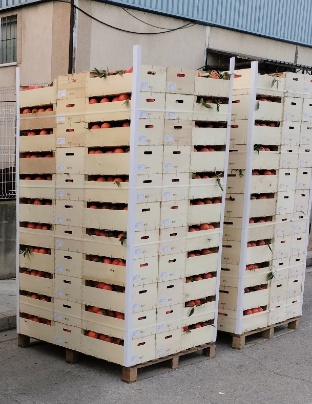
From the tree to your door
It’s picked the day we prepare your order and leaves Albalat straight for your door.
What's available this week
The catalogue changes with the fields: it shows what’s being picked and hides what isn’t.