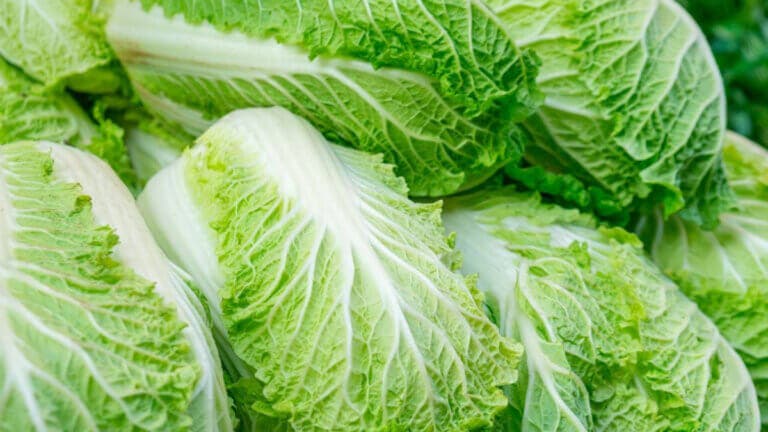
Chinese cabbage has a problem: nobody knows what to do with it. It looks like a long lettuce, it
doesn’t behave like a lettuce and it isn’t a white cabbage either, so it sits in the drawer being
looked at.
This is the recipe that gets it into the house for good. Five minutes in the pan,
a clove of garlic and a squeeze of lemon at the end. And one trick that changes the result
completely.
- Preparation10 min
- Pan8 min
- Total18 min
- Serves4
Ingredients
- 1 Chinese cabbage (about 900 g)
- 3 cloves of garlic
- 40 g pine nuts or flaked almonds
- 4 tablespoons extra virgin olive oil
- The juice of half a lemon
- Flaky sea salt, better than fine
- A dried chilli, optional
- A teaspoon of orange blossom honey, optional
- A handful of raisins, if you like the sweet contrast
How it’s made
- Separate the white from the green. Cut the head across and you’ll see it holds two
vegetables: the white rib at the base, crunchy and juicy, and the fine green leaf. Make two piles.
This is the whole trick of the recipe.
- Cut. The white into finger-wide strips; the green wider, because it’s going to shrink a
lot.
- Wash and dry it well. If it goes into the pan wet, the cabbage boils in its own water
instead of frying.
- Toast the pine nuts in the dry pan, over a low heat, keeping them moving. Take them out
and set them aside.
- Brown the garlic sliced, in the oil, over a medium heat, with the chilli if you’re using
it. The moment it starts to colour, turn the heat to maximum.
- Put in the white and stir-fry for two minutes, shaking the pan. It should end up
translucent outside and crunchy inside.
- Add the green and stir-fry for ninety seconds more, no longer. It will shrink by
half and stay bright in colour.
- Off the heat, the salt, the lemon juice and the pine nuts. If you like the contrast, the
teaspoon of honey: with the lemon it makes a sweet-sour dressing that suits it very well.
Why you separate the white from the green
It’s the difference between a stir-fry and a mess. The white rib needs about two minutes to
soften; the green leaf is done in under one. Put them in together and by the time the stem is right
the leaf has spent a minute as a rag.
And the heat, high. Chinese cabbage holds a lot of water: over a medium heat it releases it and
ends up boiled and bland. With a very hot pan and short batches, the water evaporates on contact and
the vegetable keeps its crunch.
With a small pan and a whole cabbage, the same thing happens as with any stir-fry: it piles up,
the temperature drops and what was going to be a stir-fry ends up a boiled vegetable. If your pan is
too small, two batches of two minutes beat one of five.
And the salt goes in at the end. Added at the start, it draws the water out of the cabbage at
exactly the point when you want it kept in.
How far one cabbage goes
Here’s the other reason to buy it: a head weighs between 800 grams and a kilo and a
half and almost nothing gets thrown away. Only the hard base of the stem, a couple of
centimetres.
One cabbage gives four servings of stir-fry, or two stir-fries and a salad, and as it keeps for
weeks there’s no rush to use it all at once. The way that works best is to use it in two registers:
the outer half, more tender, raw in a salad during the first week; the heart, tighter and crunchier,
stir-fried afterwards.
And if there’s stir-fry left over
It keeps two or three days in the fridge and is eaten cold, as a warm salad, with a bit more
lemon. Reheated it loses its crunch, so cold beats a second turn in the pan.
What it goes with
- As a side for grilled fish or roast chicken.
- With a fried egg on top, and that’s dinner.
- With rice from the day before, fried in the same pan.
- With prawns, added just before the green.
- Cold, the next day, dressed with more lemon: it turns into a salad.
And the other way: in the hervido
Worth saying plainly: Chinese cabbage is not a Valencian vegetable. It arrived
recently and it’s grown here because it does well in the cold months, when the fields have little to
give.
But it fits without forcing anything into the winter dish of any household in the Ribera: the
hervido, the plain boiled vegetables that are eaten here all winter.
Potato, green beans, onion, a slug of raw oil and salt. The Chinese cabbage goes in
in the last five minutes — it takes far less time than white cabbage — and brings a
texture the usual cabbage doesn’t have.
The same goes for a puchero, the winter stew: cut into wide strips and added at the end,
it doesn’t fall apart and it doesn’t leave that strong smell that puts so many people off
cabbages.
How to choose it and how long it lasts
A tight head, heavy for its size, with firm outer leaves and a clean white base. If a stem is
poking out of the centre it has bolted and it will taste bitter.
And here’s its best quality: whole and unwashed it keeps two or three weeks in
the vegetable drawer, which no other leafy vegetable manages. The outer leaves act as the wrapping,
so they don’t come off until the moment you use it. More in
what to do with Chinese cabbage.
Ours
Chinese cabbage is cut in Albalat de la Ribera from October
to June — it’s a cold-weather plant: in the heat it bolts — and it leaves for your home within 24 or
48 hours, whole and unwashed, which is how it keeps best.
It’s in the vegetables section right through its season,
along with the two squashes.
How do you stir-fry Chinese cabbage without it going soft?
By separating the white stem from the green leaf and putting them in two
minutes apart, with a very hot pan and the vegetable properly dry. Over a medium heat it releases
water and boils.
Can Chinese cabbage be eaten raw?
Yes: finely shredded it replaces lettuce in winter and stands up to a
dressing without wilting. Stir-fried it takes two or three minutes.
Can it go into a boiled vegetable dish or a stew?
Yes, cut into wide strips and added in the last five minutes: it takes far
less time than white cabbage and doesn’t leave the strong cabbage smell.
How long does a Chinese cabbage last?
Whole and unwashed, between two and three weeks in the vegetable drawer.
Once started, about a week longer if it’s kept cut side down.
Is Chinese cabbage the same as pak choi?
No. Chinese cabbage forms a long, tight head of white leaves; pak choi is
smaller, doesn’t close into a head and has separate dark green leaves. They’re cooked in much the
same way, but pak choi keeps a good deal less well.