If you go looking for Valencian oranges in August, you won’t find any freshly picked. You can
buy oranges — there are plenty in any supermarket — but they come from the southern hemisphere or
they have spent months in a cold store. The orange season in Valencia runs from November
to July, and within those nine months each variety has its moment.
Here is the real calendar, the one we follow in the fields of the Ribera del Xúquer to decide
what gets picked each week.
The season, month by month
The season starts in November with the early
varieties and stretches to July with the late ones. It isn’t a fixed date: every
year it moves a week or two depending on how the autumn comes in. A warm October delays ripening;
a cool one brings it forward.
| Variety |
When it’s picked |
What it’s best for |
| Navelina |
November to January |
Eating. The first of the year |
| Salustiana |
December to March |
Juice. Few seeds, plenty of juice |
| Navel, Navelate and Sanguinelli |
January to March |
Eating. The classic navels and the blood orange |
| Navel Lane Late |
February to May |
Eating. Holds well on the tree |
| Powell, Barnfield and Chislett |
March to June |
Eating. Late navels |
| Valencia Late |
April to July |
Juice. The juiciest of them all |
Outside that window there is no freshly cut Valencian orange. What is sold in August,
September and October is either cold-store fruit — kept since the spring — or imported from South
Africa, Argentina or Uruguay, where the seasons run the other way round.
The easiest test: look at the label. If in August it says “origin Spain” and
the orange is flawless, it has almost certainly spent months in cold storage. Fruit picked in
season doesn’t all come out equally good-looking.
Which orange there is at each point
Saying “orange” is like saying “apple”: inside there are varieties that behave very
differently. These are the four that shape the Valencian season.
Navelina: the one that opens the season
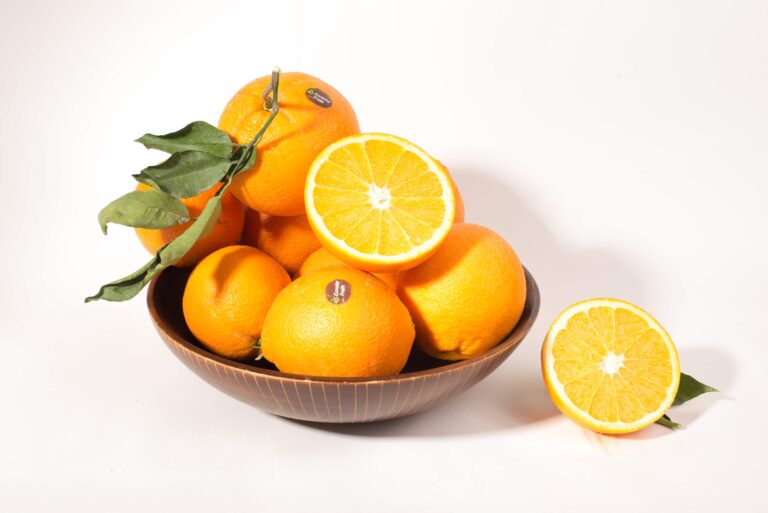
It’s the first to arrive, from November, and the one you see at Christmas. You
recognise it by the navel — that small secondary fruit at the base, which is what
gives the “navel” group its name. It’s easy to peel, with firm segments and no seeds.
It’s an eating orange: for having in segments. It works for juice, but with
one thing worth knowing: navels contain a compound called limonin that makes the juice
turn bitter if you leave it standing. Freshly squeezed it’s perfect; half an hour
later, less so. If you’re making juice for the whole morning, go for a Salustiana.
Salustiana: the winter juicing orange
It comes in in December and lasts until March. It has no navel and practically no seeds. Its
skin is finer and its segments juicier, so it yields considerably more in the juicer.
It’s the one we recommend if what you want is juice in the middle of winter,
when the Valencia Late hasn’t arrived yet.
Navel Lane Late: the mid-season one
It’s a mutation of the classic Navel that ripens later, from February to May. Its virtue is
that it holds on the tree without losing quality, which makes it possible to pick
it to order for months. Slightly rougher skin, balanced flavour, very easy to peel.
Valencia Late: the best one for juice
The one that closes the season, from April to July, and the juiciest of the four. It’s the
variety that made Valencian oranges famous worldwide and the one the juice industry uses.
It has an oddity that throws people: in spring, with the heat, it can turn green again
on the outside even though inside it’s perfect. It’s called regreening and it’s a natural
process. A Valencia Late with slightly greenish skin in May is usually at its very best.
Why there are no Valencian oranges from August to October
Because the orange tree blossoms in spring — that’s the orange blossom
the honey comes from — and the fruit takes between
eight and twelve months to ripen. By the time August arrives, the oranges on the tree are green and
the size of a walnut: they belong to the following season.
That leaves three months, from August to October, with no home-grown orange. The industry covers
them in two ways:
- Cold stores. Oranges picked in spring and kept in controlled cold for months.
They keep, but they lose aroma and juice.
- Imports from the southern hemisphere. South Africa, Argentina, Uruguay or
Peru, where it’s winter when it’s summer here. Good fruit, but with thousands of kilometres and
weeks at sea behind it.
That’s why our catalogue changes on its own and there are no boxes of
oranges from August to October. We’d rather say there aren’t any than sell one we haven’t picked ourselves.
It’s set out in more detail in From tree to table.
How it’s decided that an orange is ready
It isn’t cut by the calendar. It’s cut when the fruit reaches a point that can be measured, and
that’s the difference between an orange that tastes of something and one that is merely the right
colour.
The balance between sugar and acidity
That’s the criterion that governs. The sugar in an orange is measured in degrees
Brix and the acidity in grams of citric acid per litre of juice. What matters is not each
number on its own, but the ratio between the two.
European rules require a minimum before an orange can be sold as such, but that minimum is just
that: a legal floor. An orange that has only just met the standard is edible and fairly bland. The
one that really tastes of something is well above it, and to get there it has to stay on the tree
for weeks longer.
That’s the conflict running through the whole chain: every extra week on the tree is better
fruit and more risk of a storm bringing it down. Anyone who has to fill a lorry every day cuts
earlier. Anyone who picks to order can wait.
Colour is deceptive
An orange can be orange outside and green inside, and the other way round. The colour of the
skin depends mostly on the night-time temperature: cold destroys the chlorophyll
and lets the orange underneath show through. That’s why in warm countries there are oranges that
are ripe and green, and why the Valencia Late regreens in spring.
Colour being useless as proof has an awkward consequence: in conventional fruit,
degreening is used — putting the fruit in chambers with ethylene so it loses the
green sooner. The fruit doesn’t ripen any further; it just changes colour. It’s legal and very
widespread, but it explains why there are already perfect-looking oranges in October.
And size tells you nothing
Size depends on the variety, on how heavily the tree is cropping and on the water it has had,
not on ripeness. A small orange from a heavily laden tree can be better than a large one. If
anything, at the same size, choose the one that weighs more.
How to tell whether an orange is in season
Without seeing the tree, there are four signs that rarely fail:
The month
It’s the most reliable of all. From November to July, Spanish oranges in season
exist. Outside that, they don’t.
The weight
An in-season orange weighs more than it looks, because it’s full of juice. Pick it up: if it
feels light for its size, it has lost water in the cold store.
The skin
Freshly picked, unwaxed fruit has matt, not shiny skin. That shop-window shine
comes from the food-grade waxes applied so the fruit survives the journey without drying out. We
don’t use them, and that’s why our peel can be zested.
The leaf
If it comes with a green, firm leaf, it was cut recently. It’s the most direct sign of all: a
leaf doesn’t survive weeks of cold storage looking good.
And if you buy direct, does anything change?
The starting point changes. When fruit is picked after somebody has ordered it,
there’s no need to cut it green so it survives the journey, or to wax it so it doesn’t lose water
on the way. It’s cut ripe because it will reach its destination in 24 or 48 hours.
That’s what we do in Albalat de la Ribera: the order comes in, it’s cut that week and it goes
out. You can see the boxes of oranges when the season is open, and
the exact times in Shipping.
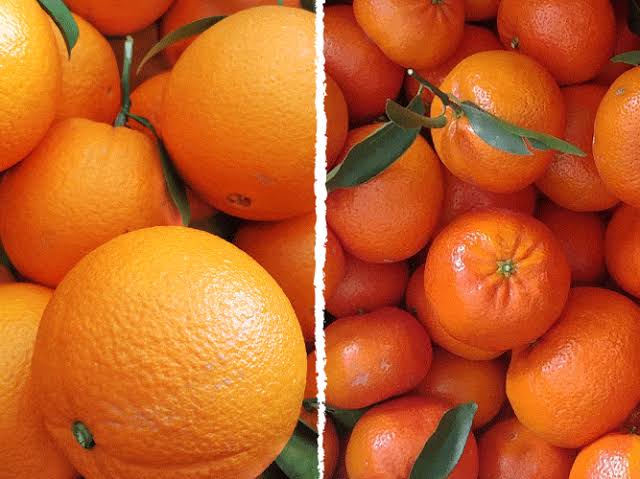
Mandarins run almost in parallel
If you’re interested in the full calendar of Valencian citrus, mandarins overlap with oranges
but start earlier and finish earlier:
| Group |
When |
What sets it apart |
| Satsuma |
September to November |
The earliest. Seedless, loose skin |
| Clementine |
November to January |
The most flavoursome and the easiest to peel |
| Late hybrids |
January to May |
They close the season, sweeter and with seeds |
Which is why the best time to order a mixed box is between November and
January, when the clementine and the Navelina are both at their peak.
When does the orange season start in Valencia?
In November, with the Navelina variety. The
date moves a week or two each year depending on how the autumn comes in: a warm October delays
ripening.
How late do Valencian oranges last?
Until July. The last variety of the season is the Valencia Late, picked
from April to July and the juiciest for juicing.
Which orange is best for juice?
The Valencia Late, from April to July, is the juiciest. In the middle of
winter, the Salustiana. Navel varieties such as the Navelina will do, but their juice turns bitter
if it stands for more than half an hour.
Where do the oranges sold in August come from?
From cold stores, where they have been kept since the spring, or from the
southern hemisphere: South Africa, Argentina, Uruguay or Peru, where it’s winter when it’s summer
here. In August there is no freshly cut Valencian orange.
Why are some oranges green in spring and still good?
It’s called regreening and it happens to the Valencia Late with the heat:
the skin takes back chlorophyll even though the fruit inside is ripe. A slightly greenish Valencia
Late in May is usually at its very best.