
Why buy fruit directly from the grower

On this page
- 1. The time since cutting
- 2. It can be cut ripe
- 3. The treatments can be skipped
- 4. The season stops being decoration
- And now what doesn’t play in our favour
- What we aren’t going to say
- Who it suits and who it doesn’t
- What’s on the other side
- How to tell whether the seller really is the grower
- How to start without getting it wrong
«Buy from the grower» sounds like a slogan, and like all slogans it has been used so much it no
longer says anything. So let’s be concrete: what exactly changes when a box goes from
the field to a house without passing through anyone else.
Four things really change, and two don’t play in our favour and also have to be said if the
explanation is meant to be worth anything.
1. The time since cutting
It’s the main difference, and almost all the others come out of it.
| Route | From tree to your kitchen |
|---|---|
| Direct sale | 24 to 48 hours |
| Short chain with a depot | Several days |
| Conventional distribution | Weeks |
| Cold-store fruit | Months |
| Imported from the other hemisphere | Weeks at sea, plus the rest |
That first row isn’t a marketing promise: it’s what allows everything else to exist. When the box is
filled the same day it leaves, none of what a long chain needs to survive the journey is necessary.
And time, in fruit, isn’t neutral: it takes water and aroma. Fruit transpires even
in cold, so every week of waiting costs it weight — which is juice — and evaporates part of the
essential oils in the peel, which are the smell. Hence a cold-store orange weighing less than it looks
and smelling of little.
2. It can be cut ripe
Fruit that’s going to travel and then wait can’t be picked at its peak: it has to be given a margin.
That margin is paid for in sugar.
And with citrus there’s no fixing it later, because it doesn’t ripen after being
cut. An orange picked green stays green inside for good: it gains no sugar and loses no
acidity. The only thing that can be changed is the colour of the skin, in a chamber with ethylene. It’s
explained in what seasonal fruit means.
When the box is filled after the order comes in, that calculation disappears: what’s ready that week
is what gets cut.
3. The treatments can be skipped
With no industrial washing there’s no natural wax to replace; with no cold store there’s no need for
post-harvest fungicide; with no shelf there’s no need for shine.
It isn’t a virtue: those steps exist to solve problems that don’t arise here. A
packhouse supplying a chain can’t afford to skip them. The full journey, step by step, is in
what goes on a supermarket orange.
The most useful practical consequence is that the peel can be used: zesting,
candying, flavouring. When you can and when you can’t is in
zesting citrus peel.
4. The season stops being decoration
A supermarket shelf always looks the same because it has cold stores and several hemispheres behind
it. A catalogue that shows what’s being picked that week doesn’t.
That means four months a year with no oranges, a persimmon that lasts ten weeks and
vegetables that appear and disappear. It’s inconvenient, and it’s also the only way that, when
something is there, it’s really there. We set it out plainly in
From tree to table.
And now what doesn’t play in our favour
It would be easy to stop here, but two things are lost and it’s worth saying so before you find them
out yourself.
You have to buy in quantity
A box is 15 kilos, not three oranges. Direct sale works because the delivery cost is spread over a
volume that makes it worthwhile, and that means buying for several weeks and having somewhere to keep
it. If you live alone and eat little fruit, an order can be too much.
How long it lasts and where to keep it is in
how to keep oranges.
And you have to wait
It isn’t a supermarket. A day or two passes between the order and the box, and there’s no way to
have fruit this afternoon. The exact times are in Shipping.
What we aren’t going to say
There are three arguments used a lot in this territory that we aren’t going to use:
- That supermarket fruit is unsafe. It isn’t. The treatments are authorised and
monitored. - That it’s always cheaper. It depends on the month, the product and what you’re
comparing it with. At the height of the season, buying direct usually works out well; out of season we
simply have nothing to sell. - That it has special properties. An orange is an orange. What changes is the sugar
it managed to make and the aroma it keeps, and that’s plenty.
Who it suits and who it doesn’t
It isn’t for everyone, and saying so avoids disappointment.
It suits you if
- Fruit gets eaten daily at your house, or juice gets squeezed in the mornings.
- There’s somewhere to keep it: a pantry, a covered balcony, a cool room.
- You can plan a couple of days ahead.
- And the peel interests you, because you bake or cook with zest.
It doesn’t suit you if
- You need variety more than quantity: there are four or five things here depending
on the month, not forty. - You’re buying for today. There’s no immediate delivery.
- Or you live somewhere without reasonable delivery. The areas covered are in
Shipping.
One arrangement that works well when the quantity is too much is splitting a box between two
households. Fifteen kilos between two families is a perfectly sensible purchase, and it’s how
a lot of people start.
What’s on the other side
Behind the box there’s a small company in Albalat de la Ribera, in the Ribera del Xúquer, with its
fields, its warehouse and its people. Who’s who is in About us.
That has a consequence you notice in practice: if something arrives wrong, it gets sorted by
somebody who knows which field that box came from. There’s no complaints department, there’s a
phone number and an email. Write to us with a photo and it gets fixed.
And it also means the fruit you buy sustains a particular field in a particular district.
How to tell whether the seller really is the grower
«Direct from the grower» has become a claim used by plenty of people who grow nothing. These are the
signs that tell a producer from a reseller with a nice website, and they hold for any shop, not just
this one.
The catalogue empties
The hardest one to fake. A grower has no oranges in August, no persimmons in March, no aubergines in
January. If a shop has everything all twelve months, that fruit comes from a cold
store or a wholesaler, however field-like the photographs.
It says where it’s from
A town, a district, a name. Not «from the finest fields in Spain» or «Spanish origin»: somewhere
specific you can look up on a map.
It knows which variety there is this week
Whoever does the picking knows whether it’s Navelina or Salustiana coming in this week, and why. A
reseller sells «oranges».
The calendar constrains it
A grower tells you when the season starts, that it’s running late this year or that there are few
persimmons left. That language can’t be improvised.
And the company details are visible
A tax number, a physical address, a phone somebody answers. Ours are in
Contact and in the legal notice, and the warehouse is where it says it
is.
How to start without getting it wrong
- Look at the month. What’s in the shop is what’s being
picked: if something isn’t there, there isn’t any. - Start with one box. Fifteen kilos is already plenty for a first time.
- Think about where you’ll keep it before ordering.
- And if you’re unsure about the variety, ask first: we’ll tell you what’s coming in
that week.
What are the advantages of buying fruit direct from the grower?
That it’s cut ripe, arrives within 24 or 48 hours and needs no cold store,
waxing or post-harvest fungicide. That translates into more weight — which is juice — more aroma and
peel you can use.
Is buying direct from the producer cheaper?
It depends on the month and the product. At the height of the season it
usually works out, especially buying by the box. Out of season there’s no comparison to be made,
because there’s simply nothing to sell.
Why do you have to buy so much at once?
Because the delivery cost is spread over the weight, and below a certain
amount it doesn’t add up for anyone. A 15-kilo box lasts two to four weeks in an ordinary household.
Is supermarket fruit worse?
It isn’t unsafe or bad: it’s regulated and monitored. What it carries is
time, and time costs it water and aroma. A cold-store orange weighs less and smells less than one cut
this week.
What happens if the box arrives in poor condition?
It gets sorted. Write to us with a photo and we’ll look at it: on the other
side there’s a small company that knows which field that box came from.
Search the blog
Right now in the fields
Being picked in September:
Lemons · Orange blossom honey · Italian frying pepper · Aubergine · Squash
Latest
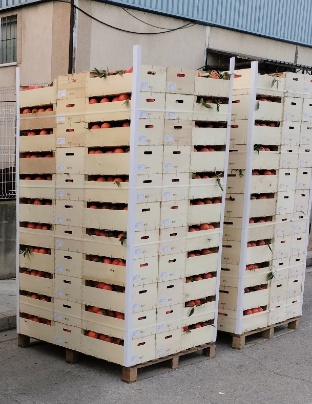
From the tree to your door
It’s picked the day we prepare your order and leaves Albalat straight for your door.
What's available this week
The catalogue changes with the fields: it shows what’s being picked and hides what isn’t.