

How to keep oranges so they last for weeks

On this page
- The golden rule
- How long they last, by where you put them
- Where to put them, step by step
- Check them every three or four days
- Why unwaxed fruit behaves differently
- Tricks that do work
- And if you still have too many
- And the rest of the order: mandarins, lemons and persimmons
- How they arrive, and why that matters
The box arrives, you open it, and the question appears: where do I put fifteen kilos of
oranges? It’s what we get asked most after a first order, and there’s a good answer: kept
properly they hold for three or four weeks without losing anything.
Almost all of it comes down to three things — air, cool and no piling — but each has its
reason.
The golden rule
An orange is still alive after it’s cut. It breathes, it transpires and it loses water little by
little. Keeping it well isn’t stopping that, which can’t be done, but giving it the
conditions to go slowly: a cool temperature, air moving, and nowhere for humidity to
collect.
If you take one sentence away: cool, airy, in a single layer and out of the sun.
The rest is detail.
It’s worth understanding why, because it explains every recommendation that follows. Heat speeds
up the fruit’s respiration and with it the water loss; still air lets the humidity the orange itself
gives off build up, and that humidity is what mould needs to get started; and contact between fruit
creates blind spots where both things meet. Changing where you put it costs nothing and triples how
long the box lasts.
How long they last, by where you put them
| Where | Temperature | How long they hold |
|---|---|---|
| Kitchen, next to the oven or a radiator | 22-25 ºC | 5 to 8 days |
| Living room, ordinary fruit bowl | 19-22 ºC | 10 to 14 days |
| Pantry or unheated room | 12-16 ºC | 3 to 4 weeks |
| Covered balcony, garage or cool store room | 8-12 ºC | 4 to 6 weeks |
| Fridge, salad drawer | 5-8 ºC | 4 to 6 weeks |
The difference between the first place and the fourth is a month, and it costs
nothing: it’s just a matter of choosing the right corner of the house.
Where to put them, step by step
Take them out of the box, or at least open it
Our boxes are cardboard with side vents and they’re made for the journey, not for keeping fruit
for a month. At home, the best thing is to tip them out onto a wide surface. If there’s no room, at
least leave the box open with nothing on top of it.
A single layer, if you can
It’s what changes most. Piled up, the ones underneath carry the weight of all the others and
humidity gathers at the contact points, which is where mould starts. On a large tray, on the pantry
floor over a piece of cardboard, or on top of a low cupboard, spread out, they last nearly twice as
long.
No plastic bag, ever
A closed bag traps the vapour the fruit itself gives off. In two days there are droplets inside
and in four, mould. If you need to contain them, better a wooden crate, a basket or a cloth bag.
Out of the sun and away from heat
Direct sun through a window warms the skin and dries it out on one side. And the three worst
places in a kitchen are, in this order: on top of the fridge, next to the oven and beside the
radiator.
Check them every three or four days
It’s the gesture that saves the whole box, and it takes a minute.
Citrus mould — that green or bluish dust that appears on a soft spot — spreads by
contact from one fruit to another, and in a few days it can take half a box. A single
affected orange, if nobody spots it, infects its neighbours.
So every three or four days it’s worth running a hand over them and taking out anything with a
soft patch, a damp mark or the slightest speck of mould. And removing that one isn’t enough: it’s
worth cleaning the surface where it was and checking the ones it was touching.
Start with the marked ones
If any arrived with a rub or a mark, eat that one first. It isn’t worse inside, but it’s where
things give way soonest.
Why unwaxed fruit behaves differently
Worth being honest about this. A supermarket orange is normally waxed and treated with
post-harvest fungicide, and that does exactly what it promises: it delays drying out and
holds off mould. It can sit on a shelf for months without flinching.
Ours carries neither, which is why it needs a decent spot. In exchange it arrives cut that same
week, with its aroma and with peel you can zest.
Put another way: treated fruit holds up anywhere on its own; untreated fruit holds up as well or
better, but in the right place.
Tricks that do work
- Newspaper or kitchen paper between layers, if there’s no choice but to stack
them. It absorbs the humidity at the contact points. - Stalk end down, if they have one. That’s where they lose most water.
- Kept away from apples and bananas, which give off ethylene and speed up the
ageing of everything near them. - The last ones, into the fridge. When less than a third of the box is left, that
remainder in the salad drawer holds for weeks more.
And if you still have too many
With fifteen kilos it happens: there comes a point where you have to get ahead of it. Three ways
out that work well.
Juice into the freezer
The best of them all. Squeeze whatever’s left, strain it and freeze it in jars or ice-cube trays.
It keeps for six months and holds its vitamin C fairly well. Note if the variety is
a navel: freezing is exactly what stops the limonin bitterness, so in that case it’s better still.
Peeled segments
Peeled and membrane removed, frozen on a tray and then tipped into a bag. They come out loose and
go straight into a smoothie.
Zest before squeezing
If you’re going to squeeze in quantity, zest the peel of the sound ones first and keep it in a
small jar in the freezer. It’s the most aromatic part of the fruit and it almost always gets thrown
away.
And the rest of the order: mandarins, lemons and persimmons
Not everything keeps the same way, and if you’ve ordered several things it’s worth knowing which
is most urgent.
| Product | Outside | In the fridge | What to know |
|---|---|---|---|
| Orange | 3-4 weeks | 4-6 weeks | The toughest of them all |
| Mandarin | 1 week | 2-3 weeks | Thin skin: single layer |
| Lemon | 1-2 weeks | Up to a month | Cut, it dries out in a day |
| Firm persimmon | 5-6 days | 2 weeks | Outside it softens, and that may suit you |
| Honey | Years | Never | Cold makes it crystallise sooner |
Mandarins first
They’re the most delicate: the skin is thin and protects less, so they mark at nothing and get
crushed if piled. On a tray in a single layer they last twice as long. Which is which by month is in
clementine, mandarin and satsuma.
Persimmons, depending on what you want
It’s the only one where time works in your favour: out of the fridge it softens and turns into
the old spoon-and-a-half persimmon. If you prefer it firm, the fridge holds it for two weeks. It’s
in what a Persimon persimmon is.
Honey, outside all of this
It’s the only product in the catalogue that doesn’t go off: in a dark, dry cupboard it lasts for
years. What cold does is speed up its crystallisation, which isn’t a fault.
How they arrive, and why that matters
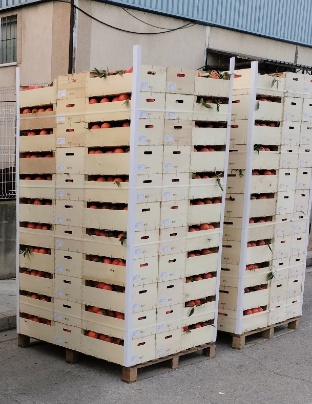
All of the above starts from one thing: the fresher it arrives, the more margin you
have. Our boxes are picked after the order comes in, in Albalat de la Ribera, and leave for
your home within 24 or 48 hours, with no cold store on the way. The exact times are in
Shipping.
An orange that has spent three months in storage starts its countdown at your house already well
advanced, however well you keep it. That’s the difference, and it’s why the catalogue only has
what’s being picked that week.
How long do oranges last out of the fridge?
Between ten days and four weeks, depending on the temperature. In a heated
kitchen, little more than a week; in a cool pantry at 12-16 ºC, three or four weeks.
Can oranges be kept in a plastic bag?
No. A closed bag traps the humidity the fruit gives off and mould appears
within days. Better an open box, a basket or a cloth bag.
Why does my whole box go off at once?
Because citrus mould passes by contact from one fruit to another. Checking
every three or four days and taking out anything with a soft patch or a speck of mould is enough,
plus cleaning the surface where it was.
Do unwaxed oranges last less?
In a bad spot, yes: wax and post-harvest fungicide delay drying out and
mould. Somewhere cool and airy the difference disappears, and in exchange the peel can be
zested.
Can orange juice be frozen?
Yes, and it’s the best way out when there’s fruit left over. Squeezed,
strained and in jars or ice-cube trays it keeps about six months. With navel varieties it’s also
what stops the juice turning bitter.
Search the blog
Right now in the fields
Being picked in September:
Lemons · Orange blossom honey · Italian frying pepper · Aubergine · Squash
Latest



From the tree to your door
It’s picked the day we prepare your order and leaves Albalat straight for your door.
What's available this week
The catalogue changes with the fields: it shows what’s being picked and hides what isn’t.