

How a box of fruit gets to your house without spoiling
On this page
It’s the last doubt before a first order, and it’s a fair one: will the fruit survive the
journey? Fifteen kilos in a box, loaded onto a lorry and unloaded in a doorway hundreds of
kilometres away.
The short answer is yes, and that what protects it isn’t the packaging but something much simpler:
that the journey is short. Here’s the whole route, step by step.
1. It’s picked after the order comes in
The decision that shapes all the others. The fruit isn’t waiting in any warehouse: it’s cut in the
field when there’s an order to fill.
That means the fruit’s countdown starts the same day its journey does, not months
earlier. An orange that has spent three months in a cold store reaches your house with half its life
spent, however well it was transported. What time does to citrus is in
what seasonal fruit means.
2. It isn’t washed
It looks like an oversight and it’s the opposite. Washed fruit starts its journey with two
disadvantages: moisture on the surface, which is what any fungus needs to get going,
and no natural waxy layer, the one the tree made to protect it from drying out.
A packhouse washes because it needs the fruit to look flawless on a shelf, and afterwards has to
replace that protection with applied wax. Here the fruit goes as it comes off the tree and gets washed
in your kitchen, just before eating. It’s set out in
why our fruit isn’t waxed.
3. The box
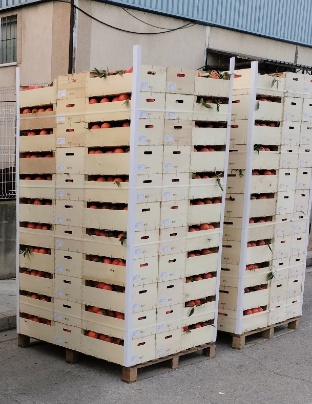
Cardboard, with side vents, and fifteen kilos. Each of those three things has its reason.
Why cardboard and not plastic
Because cardboard absorbs the moisture the fruit itself gives off during the
journey. A closed plastic crate condenses it, and that condensation spoils fruit faster than any
knock.
Why it has holes
Fruit breathes, and breathing produces heat and vapour. Without ventilation, the inside of a full box
turns into a warm, humid chamber. The side vents let air move within the pallet and in the lorry.
Why fifteen kilos
It’s the balance point. With more weight, the fruit at the bottom takes too much pressure and gets
marked; with less, the delivery cost per kilo rises until it stops making sense. Fifteen kilos is also,
as it happens, what lasts two to four weeks in an ordinary household: the sum is in
how many glasses of juice a box gives.
And how it’s packed
In layers, with the fruit fitted so it doesn’t move. Movement is the real enemy of a delivery: one
loose piece knocking against the others for six hundred kilometres does more damage than any drop.
4. The journey
The box leaves Albalat de la Ribera and enters the delivery network the same day it’s packed. The
times and areas are in Shipping, and they’re short by necessity: the whole
method rests on that.
Why it doesn’t travel refrigerated
Because over one or two days it isn’t necessary, and because cold has risks of its own. Citrus
suffers below 3 or 4 degrees — sunken marks appear on the skin, what’s called chilling injury — so
badly set refrigerated transport can do more harm than an ordinary lorry. The same happens at home, and
it’s in oranges in the fridge?.
The fruit that needs cold in transit is the fruit that’s going to take weeks. Fruit that arrives in
48 hours doesn’t.
What can go wrong
And it does, sometimes. Worth saying before it happens.
| What happens | Consequence | What to do |
|---|---|---|
| Transport delay | An extra day in the box | Take the fruit out and air it |
| A knock in delivery | The odd marked piece | Remove it and eat the rest |
| A heatwave | The fruit arrives warm | Air it and keep it somewhere cool |
| Nobody home | The box waits in a depot | Collect it as soon as you can |
The worst case isn’t the knock: it’s the waiting. A closed box in a depot for two
extra days, with its own moisture inside, is what really shortens the fruit’s life. Which is why it’s
worth giving an address where somebody can take it in.
What to do the moment it arrives
Five minutes that triple how long the box lasts.
- Open it straight away, even if you aren’t going to eat fruit today. The first thing
is to let the journey’s moisture out. - Take it out of the box and spread it, if you can, in a single layer: a tray, a
basket or the pantry floor over a piece of cardboard. - Check piece by piece. Set aside any with a knock or a soft patch: those get eaten
first. - Find the cool spot. Between 8 and 15 degrees, out of the sun and with some air. The
full method is in how to keep oranges. - And don’t wash the lot. You wash what you’re about to eat, when you eat it.
What you’ll see, and it’s normal
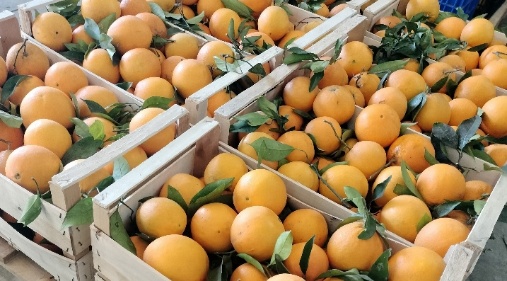
- Leaves and the odd stalk. They’re in there on purpose: a green leaf doesn’t last a
week, so they’re the cutting date in plain sight. - Pieces of different sizes. It doesn’t go through a grader.
- Rub marks and matt skin. With no waxing, the skin is what the tree gave.
- And some soil on the market garden produce, because it isn’t washed.
All of that is set out in
why untreated fruit doesn’t all look alike.
And if something arrives wrong
A box travels, and sometimes the journey goes badly. If you open it and several pieces are damaged,
the procedure is simple: a photo of the open box, exactly as it is, and
write to us.
On the other side there’s a small company in the Ribera that knows which field that box came from and
what day it was cut. There are no forms and no departments: whoever reads the email is the person who
can sort it out. Who’s behind it is in About us.
The summer case
From June to September the journey is more demanding, and it’s worth knowing if you order lemons,
honey or vegetables in the middle of August.
A delivery lorry can reach high temperatures, and a box left in a transit depot over a weekend goes
through the same. The fruit doesn’t spoil from that in 48 hours, but it arrives warm and with less
margin than usual.
Two things help a lot: ordering early in the week, so the box doesn’t spend a weekend
in transit, and giving an address where somebody will be in. And on arrival, getting the fruit out of
the box as soon as possible: that’s when it shows most.
What is true is that in summer the list gets much shorter, because
there’s no seasonal citrus beyond the lemon. Less
produce, but also fewer delicate deliveries.
Compared with the other route
| Direct box | Conventional chain | |
|---|---|---|
| From cutting to your house | 24 to 48 hours | Weeks or months |
| Stops | None | Packhouse, platform, shop |
| Washing and waxing | No | Yes |
| Cold store | No | Usual |
| Appearance | Uneven | Uniform |
| Days left when it reaches you | All of them | Whatever the journey left |
That last row is the one that matters. All fruit has a limited number of good days, and the
difference is how many have gone before it reaches your kitchen.
What’s available this week is in the shop, and why the catalogue empties for
four months a year is in From tree to table.
Does the fruit travel refrigerated?
It isn’t necessary over 24 or 48 hours, and citrus also suffers below 3 or 4
degrees. Cold is needed when fruit is going to take weeks; when it arrives in two days, what protects it
is the speed.
Why does the box have holes in it?
Because fruit breathes and produces heat and moisture. Without ventilation the
inside of the box becomes a humid chamber, which is what spoils it fastest. It’s also why it’s cardboard
and not plastic.
What should I do as soon as the box arrives?
Open it straight away, take the fruit out and spread it in a single layer,
check piece by piece and set aside anything knocked, and keep it somewhere cool and airy between 8 and
15 degrees.
Why does the fruit arrive unwashed?
Because water on the surface encourages fungus during the journey, and because
washing removes its natural waxy layer, which is what protects it. You wash it at home, just before
eating.
What if damaged fruit arrives?
It gets sorted: a photo of the open box and an email. It’s worth removing the
affected pieces as soon as possible, because citrus mould spreads by contact to the ones beside it.
Search the blog
Right now in the fields
Being picked in September:
Lemons · Orange blossom honey · Italian frying pepper · Aubergine · Squash
Latest


From the tree to your door
It’s picked the day we prepare your order and leaves Albalat straight for your door.
What's available this week
The catalogue changes with the fields: it shows what’s being picked and hides what isn’t.