
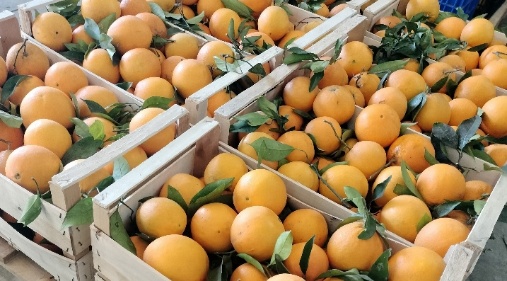
How to tell whether an orange is any good
On this page
- 1. The weight, which is the good sign
- 2. The skin: firm, thin and matt
- 3. The smell
- 4. The stalk and the leaf
- 5. The sound and the feel as you peel it
- What tells you nothing
- When an orange is past it
- What is normal in untreated fruit
- How to choose if you’re buying in a supermarket
- The definitive test: the month
In front of a crate of oranges almost everyone does the same thing: pick the biggest and the
most orange. And those are precisely the two signs that tell you nothing about
whether the fruit is any good.
There are five others that do work, and they can be checked in three seconds without opening
anything. Here they are, in order of reliability.
1. The weight, which is the good sign
If you can only do one check, make it this one. Take two oranges the same size and keep
the one that weighs more.
An orange is mostly water, and that water is exactly the juice. Fruit that has spent weeks or
months in a cold store transpires all that time and loses weight without changing much in volume:
from outside it looks the same and inside it’s half empty.
That’s why a seasonal orange weighs more than it looks and surprises you when you
pick it up. It’s the test we use in the field and the only one that never lies.
It works the same with mandarins, with lemons and with persimmons: two of the same volume, the
heavier one. You don’t need scales; the hand tells that difference perfectly well.
2. The skin: firm, thin and matt
It should give a little, and spring back
Under your thumb, the skin should give slightly and recover its shape. Hard as a ball means it
was picked too early. If it stays dented or feels hollow — skin separated from the segments — it has
been off the tree too long.
Thin, not thick
Thick skin is weight you aren’t going to eat. Within the same variety, the thin-skinned ones give
the best ratio between what they weigh and what you use.
Matt, not shiny
An orange that shines like a shop window is waxed. It’s a legal, regulated
post-harvest treatment, but it says nothing about the fruit: it says how long it has to survive on a
shelf. Unwaxed fruit has matt and sometimes slightly rough skin.
3. The smell
Bring the orange up to your nose, especially around the stalk. Seasonal fruit smells of
orange without needing to be peeled.
The aroma lives in the essential oils of the peel, and it’s the first thing lost with time and
with cold. An orange that smells of nothing can be perfectly sound and have no flavour at all: it’s
the clearest sign of months in a cold store.
4. The stalk and the leaf
If it has one, that’s free information. A green leaf doesn’t survive more than a
few days after cutting: if it arrives green and firm, the fruit was picked this week. Yellow or limp
means time has passed.
And the stalk socket should be dry and clean. Damp, soft or dark, and that’s where it will start
to go.
It’s why our boxes often arrive with a leaf inside: it isn’t decoration, it’s the cutting date in
plain sight.
5. The sound and the feel as you peel it
This one is advanced, but it works. As you peel a seasonal orange, the skin releases a
small spray of essential oil that you can see against the light and feel on your fingers.
It’s the same oil that makes your hands smell afterwards.
Old fruit peels dry, without that spray, and leaves your hands clean. It’s the closest thing to a
laboratory test you can run in a kitchen.
What tells you nothing
| Sign | What people believe | The reality |
|---|---|---|
| The colour | More orange, riper | It’s done in a chamber with ethylene |
| The size | Bigger, better | Big ones usually have more skin |
| The shine | Fresher | It’s wax applied in a warehouse |
| The uniformity | Better quality | That’s a grader, not a tree |
| The marks | It’s gone off | Usually rubs from the wind |
Colour, in detail
Worth understanding, because it’s the most expensive mistake. There’s a technique called
degreening: the fruit goes into chambers with a low concentration of ethylene, the
chlorophyll in the skin breaks down and in two or three days a green orange comes out looking as
though it’s at its peak. Nothing ripens inside. The sugar doesn’t rise and the
acidity doesn’t fall.
And it happens the other way round too: the Valencia Late regreens in spring with
the heat, taking back some chlorophyll when it’s already perfectly ripe. A greenish orange in May is
usually at its very best. It’s set out in
why there are no oranges in August.
When an orange is past it
Different from the above: here it isn’t about whether it will taste good, but whether to throw it
away.
- Soft, sunken patches. The beginning of the end. If it’s small and superficial,
the rest is usable; if it covers a quarter of the fruit, out. - Green or bluish mould. Bin it, and check the ones that were touching it: it
spreads by contact. - Wrinkled, light skin. Dehydrated. Not dangerous, but there’s hardly any juice
left. - A fermented smell. Unmistakable, slightly alcoholic. It has gone over
inside. - Sunken brown marks after the fridge. That’s chilling injury, from keeping it
below 3 or 4 degrees. It’s in oranges in the
fridge?.
What is normal in untreated fruit
And this is worth saying, because anyone used to the supermarket shelf finds it odd the first
time.
An orange that hasn’t been through a grader or a waxing line arrives uneven:
different sizes in the same box, the odd rub from the wind against a branch, superficial patches of
colour, the occasional greener fruit early in the season. None of that affects the inside.
In fact, perfect uniformity is a sign of the opposite: that the fruit has been through a machine
that discards anything outside the norm.
How to choose if you’re buying in a supermarket
Most of the year fruit gets bought where it can be, and the signs above still hold. With two
additions that only exist on a shelf.
Look at the country of origin
It’s compulsory and it tells you more than any sign above the display. If in August it says South
Africa, Argentina or Peru, that’s fruit in season there that has come by sea. If in August it says
Spain, it’s from a cold store: it has been kept for months.
Be wary of the net bag
Red or orange mesh bags exist for a specific reason: the colour of the net makes the fruit
look more orange than it is. They also stop you picking pieces up one by one to check the
weight. If there’s a loose option, always better.
And avoid pre-cut fruit
Citrus loses its aroma the moment it’s opened, so trays of peeled segments are almost always made
from the fruit that didn’t sell whole.
The definitive test: the month
All the signs above help you choose within a crate. But there’s one that decides before any of
them, and it’s which month you’re buying in.
Citrus doesn’t ripen after it’s cut. The sugar it has is what it made on the tree, and if it was
picked early there’s nothing to be done. That’s why a mediocre in-season orange is usually better
than an excellent out-of-season one.
| Months | What to expect |
|---|---|
| November to June | In season. Fruit cut ripe |
| July to October | From a cold store or the southern hemisphere |
The full calendar, variety by variety, is in
when oranges are in season in Valencia. And if you’d
rather skip the checking, our catalogue only has what’s being picked
that week: the box is filled after your order comes in.
How can you tell whether an orange has plenty of juice?
By the weight. Take two the same size and keep the heavier one: that
difference is juice. Fruit that has spent months in a cold store loses water without changing
volume.
Does colour show whether an orange is ripe?
No. The colour is achieved in a chamber with ethylene, in a process called
degreening that doesn’t ripen the fruit inside. And in spring the Valencia Late regreens while at its
very best.
Why do supermarket oranges shine so much?
Because they’re waxed in a warehouse, a post-harvest treatment that delays
drying out. Unwaxed fruit has matt, slightly rough skin.
Can you eat oranges with marks on the skin?
Yes, if they’re superficial rubs or patches of colour. What has to go are
soft, sunken areas and any speck of mould, which also infects the fruit next to it.
Which orange is better, the large one or the small one?
Medium-sized ones usually give the best ratio of weight to juice: very large
ones tend to have thicker skin. Size says nothing about flavour.
Search the blog
Right now in the fields
Being picked in September:
Lemons · Orange blossom honey · Italian frying pepper · Aubergine · Squash
Latest
From the tree to your door
It’s picked the day we prepare your order and leaves Albalat straight for your door.
What's available this week
The catalogue changes with the fields: it shows what’s being picked and hides what isn’t.